
This is default featured slide 1 title

Go to Blogger edit html and find these sentences.Now replace these sentences with your own descriptions.

This is default featured slide 2 title

Go to Blogger edit html and find these sentences.Now replace these sentences with your own descriptions.

This is default featured slide 3 title

Go to Blogger edit html and find these sentences.Now replace these sentences with your own descriptions.

This is default featured slide 4 title

Go to Blogger edit html and find these sentences.Now replace these sentences with your own descriptions.

This is default featured slide 5 title

Go to Blogger edit html and find these sentences.Now replace these sentences with your own descriptions.

Saturday, August 02, 2014

How to Remove Android Device Screen Lock

Many experience this when your children played or done by your own laziness and accidentally locked your Android Tablet or Smartphone. 

Protecting your tablet or mobile from unauthorized use is very necessary. This is best accomplished with the help of the excellent lock features available in your device. Android devices come with a variety of lock systems that prevent the unknown users from gaining the access of your device, and misusing the information available in it. Using the right lock system helps in making the devices less vulnerable to the unauthorized users, thus protecting them completely. The lock features not only safeguard the information present in the tablet/mobile, but also avoid hindrance in your privacy as well.


How to Reset Android Device when Screen is Locked ?

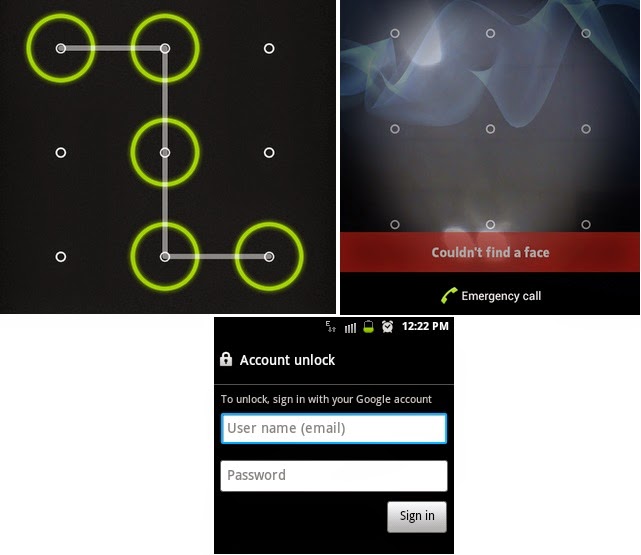
Sometimes a situation arises where your screen gets locked this becomes quite irritating and you want to deactivate the lock screen feature but your forgot the "Pattern".


Disabled by Administrator, encryption policy, or credential storage?

You wanna remove the  screen pattern unlocked  but a bunch "Disabled by Administrator, encryption policy, or credential storage" greyed out messages if I want to change it back from password lock to pattern lock for instance.

Asking for G-mail Account to Unlocked?

The instruction says that you should use  google account to unlock the tablet, but each time you logged in with  username (email) and put in your  password,  the password XXXXX username is XXXXX XXXXX also told that too many attempts sign in was performed. In short you forgot it too.

Solution : 

Factory Reset on boot up  there is a specific  combination  key for " Recovery Menu" (its like entering you computer Bios wehehe. )

NOTE: Factory  Reset will deleted all your Personal Data!!

How to Enter Recovery Menu


1.Restart your Android Phone or Tablet.

2.Press and Hold Volume Up + Power buttons (if your tablet does not have Volume Up, hold Home -the button in front- and Power buttons) for 10-15 seconds.

If you dont see a Recovery Menu Restart your Device and Do.
Press and hold the Back (arrow pointing back) and Power buttons at the same time for 8-10 seconds. Do you see the Recovery menu come up?  

3. Your device should boot with  Recovery Menu.

 Sample of Android device I tested  O +  (O plus)  and Samsung Galaxy Exhibit


 4.  Now Do this Step
To Select Menu Press  Volume Key  (-)  (+)
To Enter the selected Menu  Press  (power)
  1. First select wipe data / Factory Reset.
  2. Select Yes - Delete all user data.
  3. Once done, select Reboot system now. Y
  4. Android Device will reboot.
  5. Setup again and use it.


Friday, August 01, 2014

BadUSB Exploit -Thumdrive that hacks computer

When creators of the state-sponsored Stuxnet worm used a USB stick to infect air-gapped computers inside Iran's heavily fortified Natanz nuclear facility, trust in the ubiquitous storage medium suffered a devastating blow. Now, white-hat hackers have devised a feat even more seminal—an exploit that transforms keyboards, Web cams, and other types of USB-connected devices into highly programmable attack platforms that can't be detected by today's defenses.

Stealthy attack that reprograms USB device firmware

Back in the early days of 3G dongles, they would show up as both the dongle itself and as a virtual CD drive from which to install the device driver from. this attack vector is the same concept, only for malicious intent and not built into the device intrinsically. 

There's nothing stopping a USB Flash Drive being fully functional as a USB Flash Drive whilst also surreptitiously acting as a keyboard if it's firmware has been modified to advertise it as such. A USB device can have multiple device ID's and able to process commands as any of them.


My understanding is that if you plug it in, it will infect, auto play or not, and that this is not limited to any one operating system. This attack vector uses the actual firmware on the USB device, which tells the computer the type of device being plugged in. So you plug in an infected usb storage device, and it tells the computer that it's also a keyboard. Then it types commands as though you were doing it at your actual keyboard. 

Same as BadBios

The capabilities of BadUSB closely resemble the mysterious badBIOS malware security consultant Dragos Ruiu said repeatedly infected his computers. Nine months after Ars reported security researchers were unable to independently reproduce his findings, that remains the case. Still, Nohl said BadUSB confirms that the badBIOS phenomena Ruiu described is technically feasible.
"Everything Dragos postulated is entirely possible with reasonable effort," Nohl said. "I'm pretty sure somebody is doing it already. This is something that's absolutely possible."


Dubbed BadUSB, the hack reprograms embedded firmware to give USB devices new, covert capabilities. In a demonstration scheduled at next week's Black Hat security conference in Las Vegas, a USB drive, for instance, will take on the ability to act as a keyboard that surreptitiously types malicious commands into attached computers. A different drive will similarly be reprogrammed to act as a network card that causes connected computers to connect to malicious sites impersonating Google, Facebook or other trusted destinations. The presenters will demonstrate similar hacks that work against Android phones when attached to targeted computers. They say their technique will work on Web cams, keyboards, and most other types of USB-enabled devices.

"If you put anything into your USB [slot], it extends a lot of trust," Karsten Nohl, chief scientist at Security Research Labs in Berlin, told Ars. "Whatever it is, there could always be some code running in that device that runs maliciously. Every time anybody connects a USB device to your computer, you fully trust them with your computer. It's the equivalent of [saying] 'here's my computer; I'm going to walk away for 10 minutes. Please don't do anything evil."
In many respects, the BadUSB hack is more pernicious than simply loading a USB stick with the kind of self-propagating malware used in the Stuxnet attack. For one thing, although the Black Hat demos feature only USB2 and USB3 sticks, BadUSB theoretically works on any type of USB device. And for another, it's almost impossible to detect a tampered device without employing advanced forensic methods, such as physically disassembling and reverse engineering the device. Antivirus scans will turn up empty. Most analysis short of sophisticated techniques rely on the firmware itself, and that can't be trusted.
"There's no way to get the firmware without the help of the firmware, and if you ask the infected firmware, it will just lie to you," Nohl explained.
Most troubling of all, BadUSB-corrupted devices are much harder to disinfect. Reformatting an infected USB stick, for example, will do nothing to remove the malicious programming. Because the tampering resides in the firmware, the malware can be eliminated only by replacing the booby-trapped device software with the original firmware. Given the possibility that traditional computer malware could be programmed to use BadUSB techniques to infect any attached devices, the attack could change the entire regimen currently used to respond to computer compromises.
"The next time you have a virus on your computer, you pretty much have to assume your peripherals are infected, and computers of other people who connected to those peripherals are infected," Nohl said. He said the attack is similar to boot sector infections affecting hard drives and removable storage. A key difference, however, is that most boot sector compromises can be detected by antivirus scans. BadUSB infections can not.
The Black Hat presentation, titled BadUSB—on accessories that turn evil, is slated to provide four demonstrations, three of which target controller chips manufactured by Phison Electronics. They include:
  • Transforming a brand-name USB stick into a computer keyboard that opens a command window on an attached computer and enters commands that cause it to download and install malicious software. The technique can easily work around the standard user access control in Windows since the protection requires only that users click OK.
  • Transforming a brand-name USB stick into a network card. Once active, the network card causes the computer to use a domain name system server that causes computers to connect to malicious sites impersonating legitimate destinations.
  • Programming a brand-name USB stick to surreptitiously inject a payload into a legitimate Ubuntu installation file. The file is loaded onto the drive when attached to one computer. The tampering happens only after it is plugged into a separate computer that has no operating system present on it. The demo underscores how even using a trusted computer to verify the cryptographic hash of a file isn't adequate protection against the attack.
  • Transforming an Android phone into a malicious network card.

No easy fix

Nohl said there are few ways ordinary people can protect themselves against BadUSB attacks short of limiting the devices that get attached to a computer to those that have remained in the physical possession of a trusted party at all times. The problem, he said, is that USB devices were never designed to prevent the types of exploits his team devised. By contrast, peripherals based on the Bluetooth standard contain cryptographic locks that can only be unlocked through a time-tested pairing process.
The other weakness that makes BadUSB attacks possible is the lack of cryptographic signing requirements when replacing device firmware. The vast majority of USB devices will accept any firmware update they're offered. Programming them in the factory to accept only those updates authorized by the manufacturer would go a long way to preventing the attacks. But even then, devices might be vulnerable to the same types of rooting attacks people use to jailbreak iPhones. Code signing would likely also drive up the cost of devices.
"It's the endless struggle between do you anticipate security versus making it so complex nobody will use it," Nohl said. "It's the struggle between simplicity and security. The power of USB is that you plug it in and it just works. This simplicity is exactly what's enabling these attacks."


Japanese Government say No more Anime and Manga Piracy

Japan decided that they're going to partner up with 15 major anime and manga publishers and send requests to 580 foreign sites to remove the content they illegally uploaded.

This affects both anime and manga. Of course we don't know which sites are going to be affected, as far as we're concerned it might not be any site we visit, but it's still something to keep in mind.

The operation starts on August 1st:
"On August 1, the government will start simultaneously sending requests to delete illegal anime and manga contents to the operators of the 580 foreign pirate sites which they have found. In addition, the operation will launch a new site to guide the fans to a legitimate site offering some 250 titles including the latest ones at a cost of several hundred yen."


The Ministry of Economy, Trade and Industry production spokesman also said this:
“We want to create a project so that anime fans overseas can enjoy Japanese content legally and without infringement worries while the profits are paid to anime production companies and publishers,”

Implying that they're going to find a solution to give us, foreigners, a way to get the manga and anime they removed legally.

Some affected site:


 More List via PDF File :  http://www.meti.go.jp/policy/mono_info_service/contents/downloadfiles/140414.pdf


DTU Fotonik Holds World High-Speed Optical Data Transfer Record 43 Terabits per second

The world champions in data transmission are to be found in Lynbgy, where the High-Speed Optical Communications (HSOC) team at DTU Fotonik has just secured yet another world record. This time, the team has eclipsed the record that was set by researchers at the Karlsruhe Institut für Technologie, by proving that it is possible to transfer fully 43 terabits per second with just a single laser in the transmitter. This is an appreciable improvement on the German team’s previous record of 32 terabits per second.

The worldwide competition in data speed is contributing to developing the technology intended to accommodate the immense growth of data traffic on the internet, which is estimated to be growing by 40–50 per cent annually. What is more, emissions linked to the total energy consumption of the internet as a whole currently correspond to more than two per cent of the global man-made carbon emissions—which puts the internet on a par with the transport industry (aircraft, shipping etc.).

However, these other industries are not growing by 40 per cent a year. It is therefore essential to identify solutions for the internet that make significant reductions in energy consumption while simultaneously expanding the bandwidth. This is precisely what the DTU team has demonstrated with its latest world record. DTU researchers have previously helped achieve the highest combined data transmission speed in the world—an incredible 1 petabit per second—although this involved using hundreds of lasers.


The researchers achieved their latest record by using a new type of optical fibre borrowed from the Japanese telecoms giant NNT. This type of fibre contains seven cores (glass threads) instead of the single core used in standard fibres, which makes it possible to transfer even more data. Despite the fact that it comprises seven cores, the new fibre does not take up any more space than the standard version.

The researchers’ record result has been verified and presented in what is known as a ‘post deadline paper’ at the CLEO 2014 international conference.
The High-Speed Optical Communications team at DTU Fotonik has held the world record in data transmission on numerous occasions. Back in 2009, these researchers were the first in the world to break the ‘terabit barrier’, which was considered an almost insurmountable challenge at that time, when they succeeded in transmitting more than 1 terabit per second—again using just a single laser. The benchmark has now been raised to 43 Tbit/s.

Milestones in DTU’s high-speed research

March 2009:
The High-Speed Optical Communications (HSOC) team at DTU Fotonik breaks the terabit barrier.
October 2009:
Researchers from DTU Fotonik set a new world record by transferring 5.1 terabits per second.
2011:
Researchers from DTU Fotonik set a new record by transferring 9.5 terabits per second.
2014:
DTU Fotonik breaks the world record yet again, transmitting 43 terabits per second

Wednesday, July 30, 2014

Philippines Wimax IP Blocked or Bad IP

You are trying to access Facebook from an IP (Internet Protocol) address that's associated with a misconfigured ISP (Internet Service Provider) or abusive behavior. If you think this is an error, please tell us more. 

Probably someone on your network has been misbehaving or abuse, causing a whole range of IP's to be blacklisted.

Example: Non Stop Scanning port by using Angry IP Scanner...


What cause this?

Clones a lots of clones your Broadband have  a clone  this the results why even legitimate Wimax user are block.

Globe Block Listed
124.6.181.40
124.6.181.38

Smart  unknown  di ako smart user :P
Check this honeypot link
http://www.projecthoneypot.org/ip_124.6.181.38

Location  Tarlac or Makati


How to Fix ?

Wimax don't use Static  IP or Permanent IP in all Frequency.
If you know how to access admin  account of your broadband  change your Frequency.
For  non pro user just  try to restart your modem or reset.
Pray to get new IP :p

NOTE: clearing  cookies  or using ccleaner will not work here because  the problem is your IP.


Other Tips  :

Minsan naman banned yung IP sa mga games , If your familiar to VPN or hide my IP you can use them. This software can  change your IP or location from one country to another.

Check this Link for VPN : http://www.google.com/cse?cx=partner-pub-8452933619823318%3A6055421482&ie=UTF-8&q=&sa=Search#gsc.tab=0&gsc.q=VPN


Israel's Iron Dome Missile Defense System Blueprints Stole by Chinese Hacking Group

The intrusions were thought to be executed by Beijing's infamous “Comment Crew” hacking group – a group of cyber warriors linked to the Chinese People’s Liberation Army (PLA) – into the corporate networks of top Israeli defense technology companies, including Elisra Group, Israel Aerospace Industries, and Rafael Advanced Defense Systems, between 10 October 2011 and 13 August 2012.

The Beijing-sponsored hacking group came into light earlier this year when the United States Justice Department in May charged five of its alleged members with with various hacking and espionage offenses. The group allegedly infiltrated United States systems involved in the nuclear power, metals and solar products industries, in order to “steal information that would provide an economic advantage” for Chinese companies.


Chinese hackers  “Comment Crew” infiltrated the databases of three Israeli defense contractors and stole plans for Israel's Iron Dome missile defense system, according to an investigation by a Maryland-based cyber security firm ‘Cyber Engineering Services Inc. (CyberESI)’.

Not just this, the hackers were also able to nab plans regarding other missile interceptors, including Unmanned Aerial Vehicles, ballistic rockets and the Arrow III missile interceptor which was designed by Boeing and other U.S.-based companies.

The three Israeli defense technology companies were responsible for the development of the “Iron Dome” missile shield. The attackers targeted the three companies through email phishing attacks.

Once the companies' security systems had been breached, they exfiltrated all types of documents, from the emails sent by a CEO to the PowerPoint presentations containing all the necessary information about Iron Dome and other sophisticated ballistic projects.

This serious allegations on the chinese group were detailed by Brian on its blog. CyberESI is not yet prepared to release the report publicly.

Although it is not exactly known that how much data the group was able to obtain, Cyber ESI identified more than 700 documents that were stolen from Israel Aerospace Industries (IAI) only, amounting to 763 Mbs including Word documents and spreadsheets, PDFs, emails, and executable binaries, Krebs reported. The actual number is believed to be much higher.

Comment Crew hacking group maintained hooks inside IAI for four months during the 2012 raid. It stole administrator credentials, planted trojans and keyloggers, and dumped Active Directory data from at least two domains.

Iron Dome is the most-effective and most-tested missile shield which is designed to intercept and destroy short-range rockets and artillery shells fired from distances of 4 kilometres to 70 kilometres away. Which makes it world's most robust, reliable and effective air defense system in existence.


 Video  Demo:


When Iron Dome Detect a Missile , Citizen of Israel will heard a Siren  and after the missile destroyed a Jellyfish Smoke in the Sky will be seen. Missile Intercepts 15 to 20 second and 90% success rate.

Video Iron Dome in Action


Subsidised by the US, the anti-missile programme Iron Dome cost a total of US$1 billion, and has been largely used during the ongoing conflict that has seen militants in Gaza firing some 2,500 "Hamas Rockets" rockets at Israel that would have landed in populated areas, hailing Iron Dome as world's most effective missile shield.


Tuesday, July 29, 2014

Otterbox Preserver Series Your Smartphone Best Friend

This Otterbox Preserver Series gonna be your smartphone’s new best friend cause it’s dustproof, waterproof and yes, it’s also shockproof.

Your adventures don’t just lead you to water. The ground is hard everywhere. This highly protective waterproof phone case is built to prevail over the drops, dings and bruises that happen when you don’t hesitate to leap into the action. 

Since most of the world is water, you’re going to run into it now and then. Don’t pass up any opportunity for fun, no matter how wet and messy. With the Preserver Series waterproof phone case you can splash right into the thick of it with your phone in hand.


  • Two-piece case with snap assembly for easy installation
  • Internal foam cushions device and holds it in place inside the case
  • Includes an adjustable lanyard for convenient carrying and tethering
  • Waterproof: fully submergible up to 6.6 ft. (2 m) for 30 minutes (IP-X8)
  • Drop protection
    Dust proof: blocks entry of dust and debris particles (IP-6X)


The Preserver’s design is simple and easy. It is made of two pieces of solid polycarbonate – a front piece that contains the screen protector and a padded back part that snaps onto the front. After placing your iPhone in the front piece, you line up the back piece and snap it in on the top, bottom, and middle. Each part snaps together with a firm noise, and there’s basically no way you’d question whether the case is installed correctly. The Preserver Series is available in a variety of colors to complement your colorful personality.


OtterBox is fully submersible for 6.6 ft of water for up to 30 minutes (IP-X8).There was absolutely no water inside of the case.  A few quick drop tests from about 3 feet onto a tile floor, and the handset was just fine. OtterBox says the case can protect from drops of up to 6.6 feet. There was next to no reduction in clarity of the iPhone 5’s Retina display.

Like other cases in the same category, a thin waterproof membrane covers the microphone and receiver. So, at times, voice callers sounded muffled. And I was also forced to speak a little louder than normal for callers on the end of the line to properly hear my voice. Thankfully, in speakerphone mode, callers came through just fine. And music played through the speakers sounded nice as well.


These lovely ladies’ actions proof enough? Look, she’s even texting underwater!
Photo by: Nicole Paler  pasensiya na Nicole ganda ng kuha chix eh :v


What’s Hot

Slim and easy to hold.
Snap-on installation is quick, easy, and foolproof.
Screen protector is actually unobtrusive.
Waterproof for 30 minutes in up to 6.6 feet of water.
Can withstand drops of up to 6.6 feet while still protecting the iPhone 5.
Attachable lanyard is a nice addition.

What’s Not

Voice calls do sound muffled.
Third-party Lightning cables sometimes don’t fit.


If your not an out door adventurer  don't bother to buy  :p . Good for your precious iPhone 5s or a Samsung Galaxy S5,


CD-R King 4G/LTE Pocket Wi-Fi Php3,990

CD-King has just released its own 4G/LTE Pocket Wi-Fi  (WR-NET-066-CC CW-LTE) that can be used on both Smart and Globe 4G/LTE networks.The device can access High-speed Wi-Fi with router functions. It gives multiple 4G/LTE access. It has Broadband/USIM modem capability. It also has Micro SD Card Slot up to 32GB. It has, Log-in WebUI admin page interface with SMS and Phonebook, file sharing from the Micro SD Card, GSM (850, 900, 1800, 1900), UMTS (2100, 1900, 850), LTE TDD (1900, 2300, 2600), LTE FDD (2600, 1800, 2100) Long-life battery.


Features
Subject to branch availability 
Barcode: 030040220140001 

MODEL: WR-NET-066-CC (CW-LTE) 

  • Pocket-size, portable
  • High-speed Wi-Fi access router function
  • Provides multiple 4G-LTE internet access
  • Broadband/USIM modem function
  • With Micro SD Card Slot up to 32GB
  • Supports Log-in WebUI Managing page
  • Supports SMS and Phonebook managing page
  • Support File Sharing from Micro SD Card
  • Supports GSM 850, 900, 1800, 1900
  • Supports UMTS 2100, 1900, 850
  • Supports LTE TDD 1900, 2300, 2600
  • Supports LTE FDD 2600, 1800, 2100 Long-life battery


  • Specification:

  • Wi-Fi Standard: IEEE802.11b/g/n
  • Wi-Fi Band: 2.412~2.484Ghz
  • Wi-Fi Security: WPA/WPA2
  • Sim Card Slot: Standard 6 PIN SIM Card interface
  • Card Slot: Micro SD/SDHC up to 32GB
  • USB Interface: Micro USB; 60cm cable
  • USB Version: High-speed USB 2.0
  • Standby Time: 240 hrs
  • Working Time: 8hrs
  • Charging Time: 4 hrs with adapter; 6hrs with USB
  • Battery: Li-ion battery, 2300mAh
  • AC Adapter: 5V DC / 1.5A~1.8A; 100V~240V, 50Hz~60Hz


    Warranty Info
    Warranty Period : 6 month
    Replacement Period : 1 week


    For your Network Choice APN Config:

    For Smartbro APN Setting: 
    Postpaid 
    APN = "smartbro" 
    Dial = "*99#"
    Prepaid 
    APN = "smartbro" 
    Dial = "*99#"

    For SmartBuddy and SmartGold: 
    APN= "internet" 
    Dial= "*99#

    For Globe APN Settings: 
    Postpaid 
    APN = "internet.globe.com.ph"
    Dial = "*99***1#"
    Prepaid 
    APN ="http.globe.com.ph" 
    Dial ="*99***1#"


    For Sun Cellular APN Settings: 
    Postpaid 
    APN="fbband"
    Dial="*99#" 

    Prepaid 
    APN="minternet" 
    Dial="*99#"
    for PLDT Weroam APN Settings: 
    Postpait and Prepaid 
    APN ="weroam" 
    Username="pldt@weroam" 
    Password="pldt" 
    Dial="*99#"


    CD-R King’s new 4G/LTE Pocket Wi-Fi can be had for only Php3,990. Do note though that not all branches have this device on hand, so it’s best to contact the company first before heading out to the nearest stall.


    Sunday, July 27, 2014

    Russian government 4 million ruble for Cracking Tor


    The Russian government is offering almost 4 million ruble which is approximately equal to $111,000 to the one who can devise a reliable technology to decrypt data sent over the Tor, an encrypted anonymizing network used by online users in order to hide their activities from law enforcement, government censors, and others.
    The Russian Ministry of Internal Affairs (MVD) issued a notice on its official procurement website, originally posted on July 11, under the title “Perform research, code ‘TOR’ (Navy),” an open call for Tor-cracking proposals whose winner will be chosen by August 20.
    The MIA specifically wants researchers to “study the possibility of obtaining technical information about users and users' equipment on the Tor anonymous network,” according to a translated version of the Russian government’s proposal. 
    Only Russian nationals and companies are allowed to take part in the competition "in order to ensure the country's defense and security." The participants require to pay a 195,000 ruble (about $5,555) application fee in order to participate in the competition.
    Tor, which was actually invented at the U.S. Navy, anonymizes the identity of an online user by encrypting their data and sending it through a unique configuration of nodes known as an onion routing system – making it difficult to trace.
    Now in the hands of a nonprofit group, the project continues to receive millions of dollars in funding from the U.S. government every year, but boasts approximately 4 million users worldwide, among them many tech-savvy digital activists in countries where technical censorship and surveillance are prevalent.
    Tor has encountered problems in Russia before. Nonetheless, the MVD had previously sought to ban the use of any anonymizing software, though the proposal was dropped last year.