
This is default featured slide 1 title

Go to Blogger edit html and find these sentences.Now replace these sentences with your own descriptions.

This is default featured slide 2 title

Go to Blogger edit html and find these sentences.Now replace these sentences with your own descriptions.

This is default featured slide 3 title

Go to Blogger edit html and find these sentences.Now replace these sentences with your own descriptions.

This is default featured slide 4 title

Go to Blogger edit html and find these sentences.Now replace these sentences with your own descriptions.

This is default featured slide 5 title

Go to Blogger edit html and find these sentences.Now replace these sentences with your own descriptions.

Saturday, July 05, 2014

Average Philippine Internet speed 155th in World According to the ASEAN DNA infographic

According to the ASEAN DNA infographic, which got its data from analyzing a month’s worth of test data from March 7 to April 5, 2014, the Philippines’ average Internet speed is pegged at 3.6 Mbps -Rappler

MANILA, Philippines – The Philippines may have an Internet speed that’s slower than what a recent ASEAN DNA infographic points to. This is based on information provided by two different sets of metrics from known Internet firms.

Cloud services firm Akamai, which distributes a quarterly State of the Internet report, revealed in its Q4 2013 results that the Philippines has an average Internet speed of 2.0 Megabits per second (Mbps).


STATE OF THE INTERNET. Screenshot of Average Connection Speed and Average Peak Connection Speed by Asia Pacific Country/Region. Courtesy: Akamai State of the Internet Report Q4 2013.
A single Mbps has a data transfer rate equivalent to 125 kilobytes per second (kBps).

Akamai also noted a remarkable peak connection speed of 32.6 Mbps in the fourth quarter of 2013, a 144% increase in peak connection speed from the Q4 2012 results.

At the same time, Akamai reported "broadband adoption rates in India, the Philippines, Vietnam, and Indonesia are all stuck well below 10%, even with the significant quarterly increases seen in India and the Philippines.”

Only 3.6% of the Philippines has an adoption rate of speeds above 4 Mbps, and only 0.2% exceed 10 Mbps.
Watch this report below.


A year's worth of analyzed data from Internet metrics firm Ookla points towards the Philippines having a general Internet speed of around 3.55 Mbps, ranking it as 155th of 190 countries. The data was gathered from April 2013 to March 2014.

 OOKLA DATA. Data from Ookla's Net Index Explorer visualization of worldwide Internet speeds. Screen shot from http://explorer.netindex.com/maps#

Myanmar and India, by comparison, show a faster general Internet speed of 4.75 and 4.4 Mbps, respectively, while Laos is slightly slower at 3.52 Mbps. 
The information from these two sources paint a stark picture of Internet connectivity in the Philippines when put beside a recent ASEAN DNA infographic, which prompted Senator Paolo Benigno “Bam” Aquino IV to urge a probe into the country’s slow speeds.

source


FREE Lost Phone Tracker -PlanB

Lookout Plan B is your last resort to find your missing phone. Lookout Plan B is the first and only 'find my phone' app on the market that helps you find your lost your phone without being installed beforehand. (Note: Plan B only works with 2.0 - 2.3 versions of Android).

After you install it, Plan B will start locating your phone using cell towers and GPS. On some phones, Plan B can switch GPS on automatically. Your location will keep updating for 10 minutes, and you will get an email each time it is located, whether the phone is moving or standing still. You can start the process again by texting “locate” to your number from any other phone. In order to locate your phone, we send you a text via SMS, so standard message rates apply.

https://play.google.com/store/apps/details?id=com.lookout.labs.planb


Thursday, July 03, 2014

Facebook Apologizes for Social Experiment

There’s always something new happening at Facebook, from its appearance to user engagement tests. Whether they’re changing the look of the newsfeed or trying out new products, it seems there is always something we need to keep up with. Infolinks gathered the latest Facebook news so you’ll have it all in one place, including why its COO apologized to users.Facebook Social Experiments.

Facebook is now apologizing for a social experiment it ran including over 700,000 users. The social media world was outraged and spoke out about having their privacy invaded.
The experiment sent the unknowing and possibly unwilling participants either positive or negative posts in their newsfeed. It then looked to see if the participants’ posts would follow the same mood.


In other words, Facebook wanted to see if emotional states are contagious. Facebook COO Sheryl Sandberg spoke to user outrage by saying the terms were “poorly communicated.” One of Facebook’s data scientists also apologized, saying that in hindsight it probably wasn’t the best decision. He claimed that the company is working hard on improving how they review data.


NASA Shadow Internet That’s 100 Times Faster Than Google Fiber

When Google chief financial officer Patrick Pichette said the tech giant might bring 10 gigabits per second internet connections to American homes, it seemed like science fiction. That’s about 1,000 times faster than today’s home connections. But for NASA, it’s downright slow.

While the rest of us send data across the public internet, the space agency uses a shadow network called ESnet, short for Energy Science Network, a set of private pipes that has demonstrated cross-country data transfers of 91 gigabits per second–the fastest of its type ever reported.

NASA isn’t going bring these speeds to homes, but it is using this super-fast networking technology to explore the next wave of computing applications. ESnet, which is run by the U.S. Department of Energy, is an important tool for researchers who deal in massive amounts of data generated by projects such as the Large Hadron Collider and the Human Genome Project. Rather sending hard disks back and forth through the mail, they can trade data via the ultra-fast network. “Our vision for the world is that scientific discovery shouldn’t be constrained by geography,” says ESnet director Gregory Bell.


In making its network as fast as it can possibly be, ESnet and researchers are organizations like NASA are field testing networking technologies that may eventually find their way into the commercial internet. In short, ESnet a window into what our computing world will eventually look like.


source: www.es.net

The Other Net

The first nationwide computer research network was the Defense Department’s ARPAnet, which evolved into the modern internet. But it wasn’t the last network of its kind. In 1976, the Department of Energy sponsored the creation of the Magnetic Fusion Energy Network to connect what is today the National Energy Research Scientific Computing Center with other research laboratories. Then the agency created a second network in 1980 called the High Energy Physics Network to connect particle physics researchers at national labs. As networking became more important, agency chiefs realized it didn’t make sense to maintain multiple networks and merged the two into one: ESnet.
The nature of the network changes with the times. In the early days it ran on land lines and satellite links. Today it is uses fiber optic lines, spanning the DOE’s 17 national laboratories and many other sites, such as university research labs. Since 2010, ESnet and Internet2—a non-profit international network built in 1995 for researchers after the internet was commercialized—have been leasing “dark fiber,” the excess network capacity built-up by commercial internet providers during the late 1990s internet bubble.


Intel wants your next PC to have no Wires

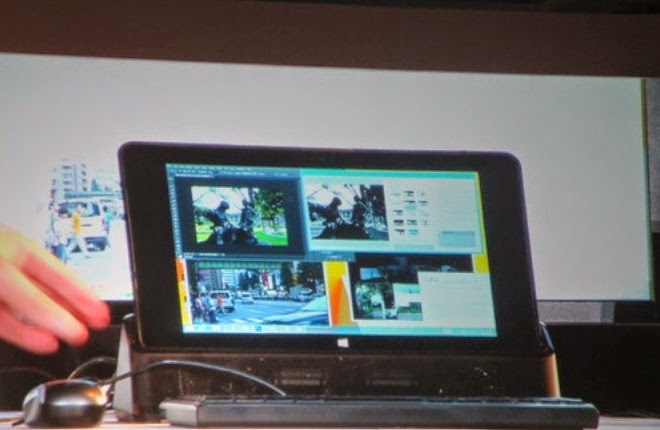
Intel is working on new wireless display, docking and connector technologies.

Intel wants to completely eliminate wires from computers, and is working on a series of wireless technologies to make that a reality in the coming years.

PCs are on the way to a "true no-wire" experience, and Intel is working on technologies to remove the clutter of power cords, display connectors and peripheral cables, said Kirk Skaugen, senior vice president, and general manager of the PC Client Group at Intel, during a speech at the Computex trade show in Taipei.

Intel is working on new wireless charging, docking, display and data transfer technologies. Skaugen shared details of the new wireless technologies and provided demonstrations of how they would work during the keynote.

Intel's hoping for a completely wire-free PC by 2016. The company will deliver a reference design of a Core processor code-named Skylake -- which will succeed the next generation Broadwell chip -- that will enable wireless docking, charging, display and data transfers.


Perhaps the biggest element in Intel's vision of a wire-free computer is the wireless technology to carry display and data signals. Intel wants to eliminate all wires from desktops with WiGig technology, which is three times faster than the latest 802.11ac Wi-Fi technology.

The WiGig wireless connection will connect desktops to displays, and also enable wireless keyboards and mice, Skaugen said. Intel is developing WiGig modules for laptops, desktops and high-resolution displays. WiGig has the potential to replace HDMI and DisplayPort technologies, and wireless modules could be integrated in PCs as early as next year, Skaugen said.

Dell already offers a WiGig dock as a bridge between monitors and PCs. The next step to a dock is to get the WiGig modules inside the computers, Skaugen said.

Intel is also chasing wireless charging. Laptops and tablets will be able to recharge simply by putting them on tables or other surfaces, much like smartphones and tablets, Skaugen said. Intel is leading the development of new wireless charging specification that will support power delivery of 20 watts and more to enable magnetic resonance wireless charging of laptops.

Skaugen showed a laptop being charged wirelessly when placed on a table. The screen got brighter as the laptop got closer to the table, indicating that the PC was being wirelessly charged. Skaugen also showed a Lenovo Yoga laptop with wireless charging.

Intel also announced it had joined A4WP, a group that defines a wireless charging specifications based on magnetic resonance. PC makers like Fujitsu, Dell and others also joined the organization. Samsung and Qualcomm are already members of A4WP.

Besides a wire-free experience, Intel also wants to make computers more interactive. PCs with 3D cameras will ship by the end of this year, Skaugen said. The 3D cameras will be able to go deeper inside images and track depth, similar to how human eyes do. The depth images will help track movement, recognize human emotions, or even track down reading habits. It is part of Intel's perceptual computing effort, in which sensory input makes human interaction with the computer easier.


Source PCWORLD


Surface Pro 3 teardown reveals fragile glass, redesigned interior

Microsoft's Surface Pro 3 is a solid step up from the original Pro, but this sleek laptop replacement is still very difficult to repair. 
Given its size, weight, and hardware specifications, the Surface Pro 3 is more a convertible laptop than a tablet. The 12-inch display, stereo speakers, a microSD card slot, a full-size USB 3 port, a Mini DisplayPort, and two 5 megapixel cameras. It comes in a variety of CPU, RAM, and storage combinations and pricing starts at $799. At 1.76 pounds, it's heavier than your average tablet, but about the same as an ultrathin laptop. Like last year's Pro, the Pro 3 is well-built and feels sturdy in your hands.


  • Very difficult to open the case: The display/front panel assembly is attached to the back cover with adhesive, and the only way to open the case is to remove the panel. That means breaking out the heat gun, hair dryer or other warming device and very carefully heating the edges around the actual display.
  • Fragile front panel glass: Removing the front panel is a slow, tedious process and the glass covering the screen is extremely thin. I cracked one edge of the panel with just the slightest amount of pressure.
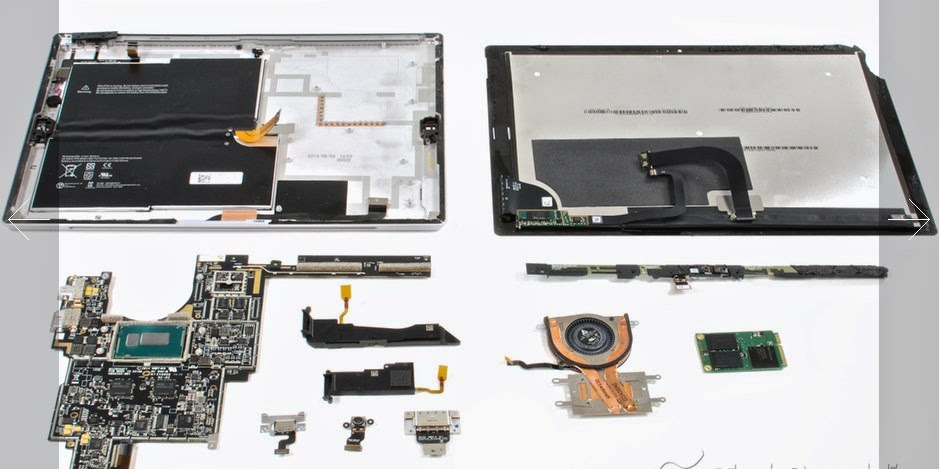
  • Redesigned interior: Microsoft completely redesigned the interior of the Surface Pro 3. Where the Surface Pro had two cooling fans, the new unit has one. The reworked main system board takes up significantly less space inside the case, the battery is no longer located under the board, and there aren't any mounting plates holding component in place.
  • Fewer, but still too many internal screws: Thankfully, Microsoft also used fewer screws inside the Pro 3 than than the earlier model, which has close to 100 screws. Unfortunately, there are still a lot of screws and they are all different sizes. As before, I recommend cataloging each screw's location as you remove it.
  • New, flat internal connectors: Several of the connectors inside the case are a kind I haven't seen before. They are held in place with screws and have a thin wafer board between the cable's connector and the motherboard. These connectors appear to be thinner than the more common "snap style" connectors.
  • Replaceable battery (sort of): The Pro's 42.2 Wh Li-ion battery isn't soldered to the motherboard and can be replaced. Unfortunately, there's so much glue holding it to the back cover, it is difficult to remove without damaging the battery. In fact, the battery is printed with the following warning "Do not separate or remove the battery from the backplate cover."


A handsome Criminal Mugshot goes viral at Stockton, Calif., Police Department offered $30,000 for more shots

A handsome criminal mugshot goes viral, many fall in love, and now he's offered $30,000 for more shots.

The Web doesn't bring out the worst in people. Truly, it doesn't.

It merely allows all the feelings, foibles, and fetishes of humanity to emerge more quickly and find like minds in the midst of the Hieronymus Bosch mass of existence.

Why not marvel, therefore, at the fall and rise of Jeremy Meeks?

Should you have been living in a swamp with Floridian crocodiles for the last two weeks, you may not know that Meeks' mugshot went, as they say, viral.

Why did it do so? Because he's ineffably handsome. So ineffably handsome that this photograph of a man accused of 11 felonies and currently being held on a $900,000 bond has been "liked" on Facebook more than 100,000 times.

As far as I am aware, this is not some psychological experiment cooked up by Facebook to attract positive publicity for its troubled service. This was merely a routine posting to the site by the Stockton, Calif., Police Department.

This one image, however, has secured Meeks an agent and a reported offer of $30,000 to model.


You see, the Web can knock you down, destroy your reputation, and ruin your self-esteem. But just look how it can change your life in the blink of a camera shutter.

Meeks was arrested last month. Police allegedly found a pistol in the trunk of his car. He is currently being held on charges that include "street terrorism." He is also being held on felony weapon charges. Already a convicted felon, it may well be that Meeks is consistently unlucky.

However, his new agent, Gina Rodriguez, told Fox News: "If this was a different situation, like if someone was actually hurt or there was violence involved, I definitely would not be taking him on. But we don't know Jeremy's full story yet, and I don't feel like he got a fair break."
I always thought that where felons and guns were involved there was always the possibility of violence. Perhaps I have merely watched too much "Nancy Grace."


Wednesday, July 02, 2014

Samsung Galaxy S5 Mini Smartphone

Samsung is rolling out a smaller version of its Galaxy S5 smartphone, less than three months after the company launched its new flagship device

The smaller version of the company's flagship device comes a day after Samsung launched four other smartphones in its Galaxy family.

The new 4.5-inch Galaxy S5 mini continues Samsung's tradition of offering a smaller, less expensive version of its flagship smartphone, and is illustrative of the company's aggressive approach in a highly competitive market that includes such heavyweights as Apple and its popular iPhone.

The new Android-running device, announced July 1, also comes a day after the Korean tech giant expanded its Galaxy portfolio of smartphones with four new devices that officials said were more affordable than other offerings.


In announcing the S5 mini, JK Shin, CEO of Samsung Electronics and head of IT and mobile communication at the company, said the goal is to offer devices designed to meet a wide range of consumer demands.

 SPECS:


Tuesday, July 01, 2014

DARPA SET FINALS FOR ROBOTICS CHALLENGE

Scientists from at least 11 robotics teams have less than a year to prepare to compete in the DARPA robotics challenge finals.

DARPA (Defense Advanced Research Projects Agency), the research arm of the U.S. Department of Defense, announced that the final stage of its three-phase challenge will be held June 5 and 6, 2015, in Pomona, Calif.

The 11 teams will compete for a $2 million prize. DARPA has stated that it expects more teams to participate.


The three-part challenge is intended to advance autonomous robots to the point that they can become viable members of search and rescue teams during natural and man-made disasters. Scientists expect that one day robots will largely act on their own to enter damaged buildings, find human victims, turn off gas pipes and put out fires.


Brett Kennedy, principal investigator for the RoboSimian, NASA's Jet Propulsion Lab entry in the DARPA Robotics Challenge during the second phase of the contest in December 2013, shows off the robot before it takes on its first task. (Photo: Sharon Gaudin/Computerworld).


The first part of the challenge was a simulation held in 2013. The second phase, which was held in December in Florida, involved 16 teams competing to see which could build the best software to enable their robot to work through a series of tasks, including autonomously walking, using human tools, climbing a ladder and driving a car.

The 11 finalists include teams from Worcester Polytechnic Institute, MIT, Virginia Tech and NASA's Jet Propulsion Laboratory.

Team Schaft, which finished in first place in the second phase of the challenge, was expected to be a tough challenger for the finals. However, Team Schaft withdrew from the finals.

Google, which owns Team Schaft and the hardware and software its roboticists built, pulled out so it could focus on commercial products. Google has bought at least eight robotics companies in the past year and appears to be focused on creating related hardware and software.

The finals are expected to be considerably more difficult than the second phase of the challenge, which had robots taking on one task at a time.

During the finals, the robotics teams will face an overall disaster situation, such as a fire or gas leak, DARPA said. The robots will be given a set of tools and a series of ladders, doors, cars and valves that they can use to handle the situation.

As an added layer of difficulty, the robots will not be connected to power cords or wired communications or tethers. If a robot falls, it will have to get back up without human assistance.


Twitter buys mobile advertising company TapCommerce

Twitter said Monday it has agreed to acquire TapCommerce a mobile advertising company focused on re-engaging people who have downloaded advertisers' apps.

The financial terms of the proposed acquisition of the New York startup were not disclosed. Some reports, however, said Twitter is paying about US$100 million for the company.

Twitter also announced Monday the global rollout of its "mobile app installs" program, which allows companies to promote their mobile apps in users' feeds.


"Consumers are starting to use their phones not just to install and use apps, but for making purchases of both virtual and real-world products and services," Richard Alfonsi, VP of global online sales at Twitter, said in a statement. "Advertisers spend aggressively to get new users, but reactivating existing or previous users can provide just as attractive a return on investment."

Twitter's latest purchase augments its already existing efforts to expand its business model beyond its core social-networking technology. While Twitter makes money from selling advertising in the form of a "promoted tweet" on the service, which can be viewed by users, it is spending big to grow a business outside its website and apps as well.

The biggest move was last September, when it reportedly spent $350 million in stock to acquire MoPub, an advertising technology firm that attempts to connect advertisers with app developers. TapCommerce already works with MoPub, the companies said, making the acquisition relatively easy.

source :CNET


No-IP.com Domains Seized by Microsoft

In an effort to crackdown on cyber crimes, Microsoft has taken a legal action against a malware network what it thought is responsible for more than 7.4 million infections of Windows PCs across the globe.

A bunch of websites got the equivalent of the "blue screen of death."
Millions of legitimate servers that rely on Dynamic Domain Name Service (DDNS) from No-IP.com, owned by Vitalwerks Internet Solutions were blacked out on Monday after Microsoft seized their 23 domain names that were being used by malware developed in the Middle East and Africa.

But in No-IP's case, the company wasn't a hacker. The problem, Microsoft argued, was that No-IP's business model lent itself to criminal abuse. Microsoft wasn't the only one that thought this. Earlier this year, Cisco's security team said the same thing about No-IP's business model.
Here's what they said was wrong: Computers prefer numbers, humans prefer words. A website has two internet addresses, one of them is numbers, called an IP address, the other is words, called a URL; together they are known as a "domain."

A system called "domain name service" (DNS) matches up the two, so when you type businessinsider.com into your browser (easier for humans to remember), you are connected to the IP address of 64.27.101.155 (easier for computers to work with).

Microsoft's problem is that No-IP uses something called Dynamic DNS, a tech that allows lots of websites to share the same numerical IP address. This isn't special to No-IP. DDNS is used in everything from corporate networks to home networks.

But DDNS websites, often called "subdomains," are not tracked the same as regular websites, making them a haven for criminals wanting to hide their activities and whereabouts, according to research done by Cisco and Microsoft. That research showed that free IP addresses, particularly those owned by No-IP, were being used regularly by hackers to distribute malware.

No-IP FOR MALWARE OPERATORS
The Dynamic Domain Name Service (DDNS) from No-IP.com works by mapping users' dynamic IP addresses to a customized No-IP sub-domain like yourhost.no-ip.org or yourhost.no-ip.biz. This mechanism allows users to connect to a system with dynamic IP address using a static No-IP sub-domain.
No doubt its a useful service, but Nevada-based No-IP Dynamic DNS (DDNS) service subdomains have been abused by creators of malware for infecting millions of computers with malicious software at large scale.
FAMOUS MALWARE FAMILIES USING No-IP SERVICE
Microsoft security research team began this operation under an order granted by a federal court in Nevada, and targeted traffic involving two malware families that abused No-IP services. The Windows malwares, which went by the names Bladabindi (aka NJrat) and Jenxcus (aka NJw0rm), use No-IP accounts to communicate with their creators in 93 percent of detected infections, which are the most prevalent among the 245 other pieces of malware currently exploiting No-IP domains.
In a blog post, Richard Domingues Boscovich, assistant general counsel at Microsoft’s Digital Crimes Unit, said Microsoft pursued the seizure for No-IP's role "in creating, controlling, and assisting in infecting millions of computers with malicious software—harming Microsoft, its customers and the public at large." He claimed.
LARGE SCALE MALWARE INFECTION AND ACCUSED AUTHORS
Over the past year, Microsoft security team has detected more than 7 million infections that makes use of Bladabindi and Jenxcus malware, in order to take control of users’ computers, steal passwords, and turn on webcams and microphones.
Microsoft accused Kuwaiti national Naser Al Mutairi and Algerian national Mohamed Benabdellah of writing and distributing the Bladabindi and Jenxcus malware, respectively. Microsoft claims the developers have sold over 500 copies of the malicious software to crooks and cyber criminals, and promoted No-IP service to use with malware to help them covering their tracks.
In a civil case filed on June 19, Microsoft named two individuals, Mohamed Benabdellah and Naser Al Mutairi, and a U.S. company, Vitalwerks Internet Solutions of violating “federal and state law by distributing malicious software through more than 18,000 sub-domains belonging to No-IP, causing the unlawful intrusion into, infection of, and further illegal conduct involving, the personal computers of innocent persons, thereby causing harm to those persons, Microsoft, and the public at large."
Microsoft attorneys said No-IP is "functioning as a major hub for 245 different types of malware circulating on the Internet."
The court in Nevada has granted a temporary controlling order against No-IP and now the DNS traffic for the hostnames associated with malicious activity being funneled through Microsoft's servers:

  • ns7.microsoftinternetsafety.net
  • ns8.microsoftinternetsafety.net
MICROSOFT vs No-IP SERVICE
Microsoft claimed, "Despite numerous reports by the security community on No-IP domain abuse, the company has not taken sufficient steps to correct, remedy, prevent or control the abuse or help keep its domains safe from malicious activity.".

In an official statement, Vitalwerks counter-accused Microsoft for allegedly affecting millions of innocent users, who are currently experiencing outages to their services because of Microsoft’s attempt to remediate hostnames associated with a few bad actors.
Unfortunately, Microsoft never contacted us or asked us to block any subdomains, even though we have an open line of communication with Microsoft corporate executives.” No-IP Marketing Manager, Natalie Goguen said.
Vitalwerks and No­-IP have a very strict abuse policy. Our abuse team is constantly working to keep the No-­IP system domains free of spam and malicious activity.” Natalie Goguen said. “Even with such precautions, our free dynamic DNS service does occasionally fall prey to cyber scammers, spammers, and malware distributors. But this heavy-handed action by Microsoft benefits no one.
OTHER POPULAR No-IP LIKE SERVICES
There are dozens of No-IP like Free Dynamic Domain Name Services (DDNS) available the Internet, those are actively being used by malware authors/operators to distribute malwares. Example:
  • http://www.dnsdynamic.org/
  • http://www.changeip.com/
  • http://freedns.afraid.org/
  • http://www.dyndns.com/
  • and many more…
Microsoft advised all of them to follow the Industry best security practices, in order to make it more difficult for cybercriminals to operate anonymously and harder to victimize people online.
Boscovich went on to say, "As malware authors continue to pollute the Internet, domain owners must act responsibly by monitoring for and defending against cyber crime on their infrastructure. If free Dynamic DNS providers like No-IP exercise care and follow industry best practices, it will be more difficult for cybercriminals to operate anonymously and harder to victimize people online."
However, No-IP has not created the malware, but the service has not taken strict steps to keep its domains safe from malicious activity. Microsoft said the case and operation is ongoing.

Buy a discount maid at Singapore's malls

In Singapore, maids are put on display and made available for 'purchase' in central shopping malls.


Go to the Bukit Timah Shopping Centre, a 1970s mall in central Singapore, and you will find five levels of brightly lit rooms and galleries called "Homekeeper" and "Budget Maid". Inside these rooms, dozens of women sit in a listless, artificial silence. They nod respectfully as you enter, and some watch closely as you speak to staff. You might take one home with you - for two years, or longer.


The women, domestic workers, come from Indonesia, the Philippines, and Myanmar. They sit beneath garish signs and posters, testifying to their friendliness and industriousness, or advertising "super promo" rates and "special discounts".


Some "maid agencies", as they're known locally, display women at work. Along one aisle, domestic workers push each other around in wheelchairs, as though they're taking care of the elderly. In another gallery, a woman cradles a baby doll and pretends to change its diapers. Others stand in mock living rooms ironing the same shirt, or making the same bed - scenes enacted elsewhere in Singapore at malls like Katong Shopping Centre on Mountbatten Road.


Jolovan Wham, executive director of the Humanitarian Organisation of Migration Economics (HOME), a migrant workers advocacy group based in Singapore, said that some agencies market their domestic workers like "commodities". He adds that racial stereotypes are sometimes used in transactions with patrons. "Some of the stereotypes include Filipinos as 'smarter', Indonesians as 'less bright' and Burmese as 'sweet-natured and compliant'."

There have also been complaints of women being underfed at certain employment agencies, according to Ummai Ummairoh, president of the Indonesian Family Network (IFN). "We always receive calls about agencies not giving enough food. In one case, an agency was spending $20 to feed 40 people."

Ummairoh, who also worked as a maid, added that the shopping centres made women look like "dolls at a supermarket".
For Anandha Nurul, a domestic worker who spent seven years in Singapore, her time at the shopping malls was marked by boredom and long hours. "They did not treat me very nicely," she said, recalling that she was fed instant noodles for the three days she was at her agency. "We didn't even boil the noodles properly. We just used warm water."

But standards vary considerably within the industry, and other agencies claim to afford female domestic workers more dignified conditions. "We should be fair and treat these workers as human beings," said Dawn Sng of PrimeChoice Maid Agency, who claims that her agency provides domestic workers with in-house training, free meals, and counselling. "We should not put them into a lower category of people."

 {Source}


The US Supreme Court has rejected Google's appeal to dismiss legal action accusing it of breaking privacy laws.

In 2010 Google admitted accidentally collecting personal data from unencrypted wi-fi networks while building its Street View program.

Its cars collected emails, usernames and passwords between 2008 and 2010.

According to USA Today, Google has been the subject of nearly a dozen civil actions. And those suing the search giant are now "pressing forward".

"In 2011, those lawsuits were combined in one class action in federal court in San Francisco," it said.
Google is accused of breaking the US Wiretap Act, which "regulates the collection of the content of wire and electronic communications" and restricts unauthorised interception.


Google argued the information collected fell under an "accessible to the public exception" clause, which permits the interception of electronic communication if it is readily accessible to the general public.

In an official blog post, the company said: "We want to delete this data as soon as possible, and are currently reaching out to regulators in the relevant countries about how to quickly dispose of it."
Google has already agreed to pay $7m (£4,1m) to settle an investigation into the matter, "involving 38 US states and the District of Columbia", according to a report from Reuters news agency.

World View Enterprises Successfully Tests Space-Tourism Balloon

A US company says it has successfully completed the first small-scale test flight of a high-altitude balloon and capsule being developed to let tourists float 32km above the Earth.

The system uses a balloon similar to that used in 2012 to lift Austrian daredevil Felix Baumgartner 128,000 feet to make a world-record breaking 24-mile sky dive. That flight also launched from the Roswell airport.
 
Poynter said last week's flight was the first testing all the components together. It used a balloon about third the size of that planned for passenger flight to lift a payload of about one-tenth of what will be used to carry passengers.

The company is still planning to begin its $75,000 per-person flights in 2016, she said. The balloons will lift a capsule carrying six passengers and two crew members 20 miles up, where they will float under a parafoil for about two hours before floating back down to earth. The capsule will be big enough for the passengers to walk around.


The selling point is the view of the Earth and seeing its curve, the company says. Other space-tourism ventures under development will rocket passengers the full 62 miles into space but on much shorter flights.


In filings with the Federal Aviation Administration, World View said it planned to launch its flights from Spaceport America in New Mexico. But Poynter Tuesday said that no final decision has been made on where to base the flights.

Spaceport is where Virgin Galactic plans to launch its first space-tourism flights at a cost of $200,000 per person. Development of Virgin's spacecraft has taken longer than originally planned, and it is unclear when the company, founded by British billionaire Richard Branson, will make its first flight. The company's newest target date is the end of this year, but it has said that for each of the last several years.


The risks of going to work at night

MANILA, Philippines – A bill has been filed in the House of Representatives seeking higher graveyard shift pay for business process outsourcing (BPO) employees.

Under House Bill 4414, graveyard shift pay is proposed to be increased from 10 percent to 25 percent of the basic salary of BPO workers working from 10 p.m. to 6 a.m.
The bill’s author, Maguindanao 2nd Distrtic Rep. Zajid Mangudadatu, said BPO employees should be properly compensated for the risks they are exposed to during the graveyard shift.
"BPO employees are often exposed to stress because they take calls of agitated or angry customers. They likewise make calls to customers of their companies for purposes of addressing concerns, making sales or other matters that require a lot of activity, resulting in undue stress. In addition, most BPOs operate during the night and this adds to the employees' exposure to health hazard," he said.
Mangudadatu said he believes that BPO firms can afford the additional graveyard shift pay for their employees, noting that the proposed increase is “just a small price to pay.”
"It should be highlighted that BPOs are owned and operated by foreigners and are in Philippine Economic Zone Authority-accredited locations. This proposed increase is just a small price to pay for owners and operators of BPOs, some of whom enjoy tax benefits for being located in PEZA-accredited locations," he said.
The bill also proposes that the additional pay shall be applied in the entire BPO industry, including those that are located in information technology centers or accredited by PEZA.
If approved, violators will be subject to a 30-day suspension of business permit and a fine of P250,000.

Monday, June 30, 2014

Windows 9 Preview Codename Threshold

"Windows 9" release due next year. ZDNet reports that a preview of codename Threshold — which may or may not be named Windows 9 once it’s released — will be available later this year. The public preview is said to arrive in the fall, shortly after Windows 8.1 Update 2 is delivered to existing machines. Microsoft had been planning to bring the Start Menu back with Update 2, but the company is now planning to deliver that change with Threshold.

 The coming operating system (OS) release -- which may or may not ultimately be branded as "Windows 9" -- is to try to make it more palatable to hold-out Windows 7 users.

In order to do this, Microsoft is working on including in Threshold lots of new features specifically aimed at "desktop" users, meaning those who interact primarily with their Windows computing device from a desktop or laptop PC with mouse/keyboard and optional touch.


While Microsoft has started to move away from the Start Screen for desktop PCs with Windows 8.1 Update, it appears that it will go further in the "Windows 9" release.  Windows that enable the Start Menu by default on desktop machines, and hide the existing Start Screen from use.


New SMS worm targets Android devices

New SMS worm targets Android devices

The Selfmite Android malware spreads by sending text messages with a malicious link to the device owner's contacts

A rare Android worm that propagates itself to other users via links in text messages has been discovered by security researchers.

Once installed on a device, the malware, which was dubbed Selfmite, sends a text messages to 20 contacts from the device owner's address book.


The rogue link points to an APK (Android application package) file called TheSelfTimerV1.apk that's hosted on a remote server, researchers from security firm AdaptiveMobile said in a blog post.
If the user agrees to install the APK, an app with the name "The self-timer" will appear in the app list.
In addition to spreading itself to other users, the Selfmite worm tries to convince users to download and install a file called mobogenie_122141003.apk through the local browser.

Other APK  usually when a user  visit a porn site.


"The impact on the user is not only have they been fooled into installing a worm and other software they may not want; the worm can use up their billing plan by automatically sending messages that they would not be aware of, costing them money," the AdaptiveMobile researchers said. "In addition, by sending spam the worm puts the infected device at danger of being blocked by the mobile operator. More seriously, the URL that the worm points to [in the browser] could be redirected to point to other .apks which may not be as legitimate as the Mobogenie app."

Most malware programs for Android are Trojan apps with no self-propagation mechanisms that get distributed from non-official app stores. Android SMS worms are rare, but Selfmite is the second such threat discovered in the past two months, suggesting that their number might grow in the future.
The text message sent by Selfmite contains the contact's name and reads: "Dear [NAME], Look the Self-time," followed by a goo.gl shortened URL.


Mobogenie is a legitimate application that allows users to synchronize their Android devices with their PCs and download apps from an alternative app store. The Mobogenie Market app was downloaded over 50 million times from Google Play, but is also promoted through various paid referral schemes, creating an incentive for attackers to distribute it fraudulently.

"We believe that an unknown registered advertising platform user abused a legal service and decided to increase the number of Mobogenie app installations using malicious software," the AdaptiveMobile researchers said.

The security vendor, which claims that its technology is used by some of the largest mobile operators worldwide, said that it detected dozens of devices infected with Selfmite in North America.
The short goo.gl URL that was used to distribute the malicious APK was visited 2,140 times until Google disabled it. That doesn't mean attackers can't create another URL and launch a new attack campaign.

Giving its current distribution model the threat is likely to only affect users who have configured their devices to allow the installation of apps from "unknown sources" -- sources other than Google Play. Most users don't enable this feature on their phones, but some do because there are legitimate apps that are not distributed through Google Play.


How to Fix Huawei BM623m Error Log-in

How to Fix Huawei BM623m Error Log-in

This is optional to fix error log in without   downgrading your BM623m .

Error Log in  Cause:
  • Forget  Password
  • Someone Change Your Password


3 times  Error  Log in


 1.  HARD RESET
Plug Your Modem
Press   the reset button hold  do not release  it for 2 minutes (press  nyo ng matagal)
Observe  the LIGHTS   All light must OFF 2 times ( dapat yung ilaw dalawang beses mamamatay lahat)

TAKE NOTE:  HARDRESET di RESET wag TANGA

Yung indicator na Nag Ha HARDRESET na yung MODEM nyo yung ILAW ng SIGNAL LIGHT 'S
Parang Nag dadowngrade kayo  ang ilaw nya ay 1 3 5  yung signal umiilaw ng may LAKTAW!

Tapos mamamatay yung lahat ng ilaw  maliban sa isa...

2. Generate Admin  Password
Link : http://blogmytuts.blogspot.com/2013/12/huawei-bm622m-admin-and-wimax-password.html

WLAN MAC Original MAC   (dapat di nyo pinapalitan eto eto yung key sa admin)

SERIAL NUMBER

Yung WLAN mag minus 2 kayo sa last Character ng MAC

BAKIT minus 2    kung nag ma minus 1 tayo  sa LAN common sense  nalang sa WLAN para makuha yun WLAN sa hindi marunong mag MINUS at hindi kabisado ang HEX

ETO and TABLE:


Ilagay sa  passgen ng 2012 -2013


Log  In na kayo


Kahit i try nyo pa now sa  alam nyo na yung password magrerestore nito ang default admin pass kahit yung default WiFi  pass kasama sa  HARD RESET

5x kuna na try sa sariling unit ko
 

You might also like: How to Enable Windows Telnet